“I will just have a cleanup.”
It is the default choice — familiar, low-commitment, and almost always leaving results on the table. Not because a cleanup is a bad treatment. It is a perfectly good maintenance service. But it is the equivalent of asking a mechanic for an oil change when what your car actually needs is a coolant flush and a brake inspection. The work gets done. The specific problem does not get addressed.
Choosing the right professional facial begins with understanding two things that are frequently confused: your skin type and your skin condition. Getting this right is the difference between a facial that produces visible, lasting results and one that leaves you vaguely satisfied without quite knowing why.
Skin Type vs Skin Condition — The distinction that changes everything
Skin type is structural. It is determined by your genetics and reflects the baseline behaviour of your sebaceous glands — how much oil your skin naturally produces. The four standard skin types are oily, dry, combination, and normal. Your skin type does not change significantly over time, though it can shift gradually with age, hormonal changes, and climate.
Skin condition, by contrast, is environmental and changeable. Dehydrated skin, congested skin, sensitised skin, and sun-damaged skin are all conditions — states that the skin is in right now, as a result of external factors, that can be treated and improved.
The most common misidentification in Indian skincare is oily skin being treated as hydrated skin. Many people with oily skin are simultaneously dehydrated — the skin overproduces oil precisely because its water content is insufficient, and the sebaceous glands are compensating. Applying moisturiser to already-oily skin feels counterintuitive, but dehydrated oily skin that receives proper hydration treatment frequently reduces its oil production. The correct facial for dehydrated-oily skin is not the same as the correct facial for simply oily skin — and the difference matters enormously for the result.
Your Aavya Wellness facialist will ask you questions before your session that are designed to identify not just your skin type but your skin’s current condition. This is standard professional practice, not a delay. The five minutes of consultation before a facial is worth more to the quality of the result than any product applied during it.
For Oily and Congested Skin
Charcoal Facial
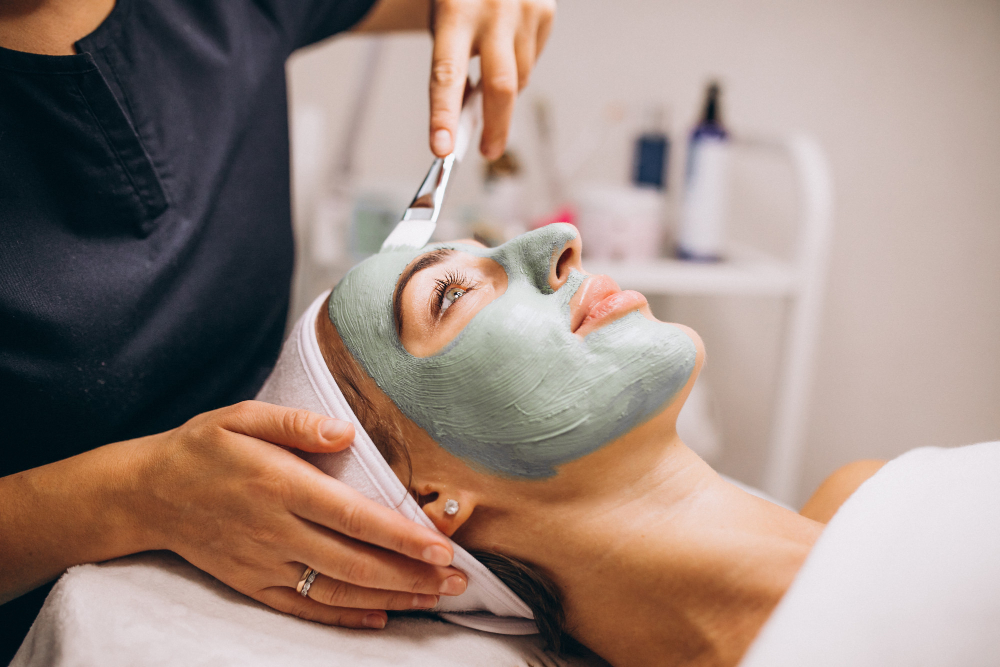
Activated charcoal is one of the most effective natural purifying agents for congested skin. It works through adsorption — attracting and binding impurities, excess sebum, environmental pollutants, and the material that collects in open pores to its surface, then being removed when the mask is lifted. The Charcoal Facial at Aavya Wellness combines activated charcoal application with deep cleansing and targeted extraction to leave oily and congested skin visibly clearer and more refined in pore appearance.
This facial is particularly well-suited to clients in urban environments — Delhi, Lucknow, Moradabad — where airborne pollutants contribute significantly to skin congestion beyond what the sebaceous glands alone are producing.
Regular Cleanup
The foundation of any consistent oily-skin routine. A proper cleanup involves thorough double cleansing, steam, manual extraction of blackheads and milia, light exfoliation, toning, and a mattifying mask. At Aavya Wellness, a cleanup is not a rushed service — it is done properly, with attention to the extraction stage that is frequently skimped in under-resourced salons. For oily skin, a monthly cleanup is a genuine maintenance investment.
For Dry and Dehydrated Skin
Superfood Radiance Facial
Antioxidant-rich superfood extracts — including compounds derived from acai, green tea, and botanical sources with high ORAC values — work at the cellular level to neutralise free radical damage and restore luminosity to dull, dehydrated skin. The Superfood Radiance Facial is one of the more immediately visible treatments on the menu: the glass-skin finish it produces after a single session is the kind of result that generates comments. For dry or dehydrated skin that has lost its glow, this is the treatment that restores it.
Marine Algae Facial
Marine algae are among the most water-binding substances found in nature — their ability to retain moisture is what enables them to survive and remain hydrated in the shifting salinity of ocean environments. Applied to the skin in a professional facial, marine algae compounds deliver deep hydration to the dermis, support the skin’s own moisture-retention barrier, and produce a detoxifying effect on skin that has been carrying environmental stress. The Marine Algae Facial is particularly effective for skin that feels persistently dry despite a home moisturising routine — because the issue is not surface dryness but barrier compromise, and algae-based compounds address the barrier directly.
For Sun-Damaged and Hyperpigmented Skin
De-Tan Facial
Sun damage and tanning are the primary skin concern for the majority of Aavya Wellness clients, and with good reason: India’s UV index is consistently high, sun protection habits remain underdeveloped across most of the population, and the cumulative effect of daily unprotected sun exposure produces uneven melanin distribution, dark patches, and a general dulling of skin tone over time. The De-Tan Facial uses melanin-inhibiting actives — compounds that interrupt the tyrosinase enzyme pathway responsible for melanin synthesis — combined with soothing agents to calm the skin during treatment. Results are visible after a single session and compound significantly with consistent monthly treatment.
Vitamin C Brightening Facial
Stabilised Vitamin C is one of the most clinically validated ingredients in modern skincare. As both a melanin inhibitor and a collagen co-factor, it addresses pigmentation and skin quality simultaneously. In a professional facial context, the concentrations used and the delivery method of the product — applied by a facialist with the benefit of steam-opened pores and prepared skin — far exceed what a consumer Vitamin C serum can achieve at home. Combined with AHA exfoliation to remove the layer of dead skin cells that dulls the skin’s surface, the Vitamin C Brightening Facial produces a clarity and evenness of tone that is one of the most requested results among Aavya Wellness clients.
For Mature Skin
Pro-Collagen Anti-Ageing Facial
The Pro-Collagen Anti-Ageing Facial is built around Padina Pavonica — a brown algae extract sourced from the Mediterranean and one of the most extensively studied plant-based alternatives to retinol for collagen stimulation. Unlike retinol, which works by irritating the skin into a repair response, Padina Pavonica activates the skin’s own collagen-producing fibroblast cells through a gentler, inflammation-free pathway. The result — firmer, plumper, more lifted skin — develops over a series of treatments rather than from a single session, making this a facial that rewards consistent investment. Combined with Marine Algae for hydration and skin barrier support, this is the most comprehensive anti-ageing treatment on the Aavya Wellness menu.
One important note for mature skin: it is frequently overtreated with heavy, nourishing products when what it actually needs is structural stimulation. Rich creams can temporarily improve the appearance of dryness without addressing the underlying loss of collagen density and cellular turnover rate. The Pro-Collagen facial addresses the underlying causes; the cosmetic improvement follows as a consequence.
For Sensitive Skin
Sensitive skin — skin that reacts readily to new products, environmental changes, or the physical stimulation of treatment — requires a thoughtful approach. The two facials best suited to sensitive skin at Aavya Wellness are the Superfood Radiance Facial and the Marine Algae Facial, both of which use formulations free of the most common sensitising agents.
If you have sensitive skin, the most important thing you can do is tell your facialist before the session begins — not when the product is already on your face. A brief conversation about your skin’s known reactions, the products it has responded badly to, and the conditions that trigger sensitivity allows the facialist to select the correct products and adjust the treatment protocol accordingly. This is standard practice at Aavya Wellness, not an inconvenience.
The Indian Skin Specific Consideration
The vast majority of skincare content — and most professional facial menus — are designed for Fitzpatrick skin types I to III: the pale to medium European range. Indian skin, which predominantly falls in the Fitzpatrick IV to V range, responds differently to several key treatments, particularly chemical exfoliants, laser-adjacent technologies, and anything that provokes an inflammatory response.
Specifically: Indian skin is significantly more prone to post-inflammatory hyperpigmentation than lighter skin types. A treatment that causes redness or minor inflammation in a Fitzpatrick III patient may leave lasting dark marks in a Fitzpatrick V patient. This means that the aggressive peel protocols common in certain Western-facing skincare clinics are not appropriate defaults for Indian skin — and that the selection of facial modality needs to account for the skin’s melanin density and inflammatory response pattern.
At Aavya Wellness, our facialists are trained to work with Indian skin types specifically — not as a variation on a European baseline, but as the primary reference point for product selection and technique.
